


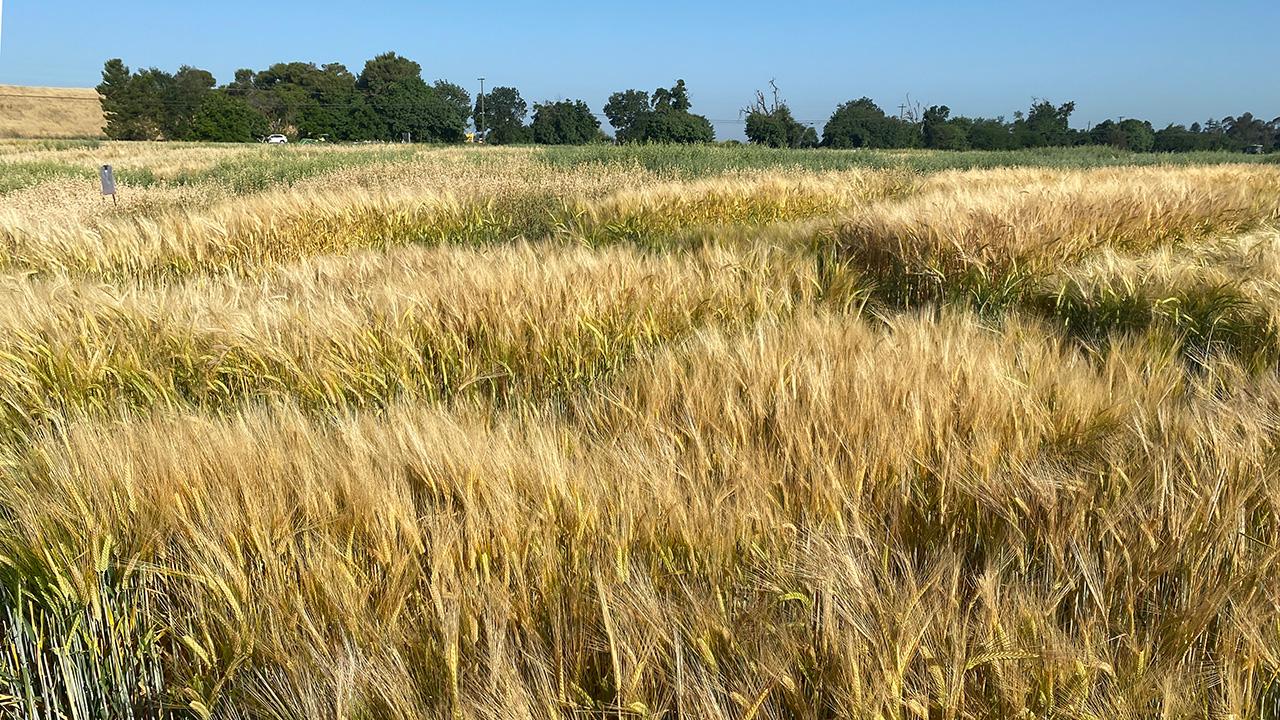
Why Plants Are Not Stupid: Introducing the “Bloom Cycle"
A newly described biochemical pathway explains key plant processes
For decades, the basics of plant growth have been taught in grade-school: Plants make their food using water from the soil, light from the sun and carbon dioxide from the air in a process called photosynthesis.
What gets less attention is, plants release some of that carbon dioxide back into the air in a parallel process called photorespiration. Most scientists think this parallel process is a waste, consuming 30 percent or more of the plant’s energy. Due to that perspective, millions of dollars have been spent over decades on research trying to eliminate photorespiration, with the aim of redirecting that “wasted” energy to boost crop production. So far, progress has been slow.

But, “plants are not stupid,” argued Arnold Bloom, a distinguished professor in the UC Davis Department of Plant Sciences. For more than three decades, he has studied photorespiration and is convinced: “Plants would not have evolved over billions of years and have kept a wasteful process.”
To explain his reasoning, Bloom has proposed a previously unrecognized biochemical pathway that is part of photorespiration. This pathway – we’ll call it the Bloom cycle – takes nitrogen the plant has absorbed from the soil and converts it into compounds essential for life, such as proteins, DNA and chemicals that deter insects and disease. An article explaining this process was published Jan. 29 in the journal Plant, Cell and Environment.
“This presents a new perspective,” Bloom said, because the cycle coordinates many key processes, including storing energy in the form of sugars and organic acids, moving energy around the plant, and regenerating chemicals needed for photosynthesis.
The Bloom cycle also unlocks a strategy for developing crop plants that are productive, yet also are nutritious and resist pests, as Earth’s climate continues to warm and carbon dioxide levels in the air rise.
“To meet those goals, you have to understand the value of photorespiration,” Bloom added. “Instead, we’ve made assumptions that may be misleading…
“We’ve been missing a significant part of what’s going on.”

Our previously unsung hero: Malate
Bloom’s hypothesis helps explain why plants with a seemingly wasteful process, which should limit their competitiveness, have managed to dominate the Earth.
The Bloom cycle creates malate, an ionized form of malic acid, made up of carbon, hydrogen and oxygen. Among other things, malate packs energy into a stable form the plant can easily move around, using its stored energy to quickly create other essential compounds such as proteins and fats.
Most importantly, plants use the energy stored in malate to assimilate nitrate – a molecule that includes nitrogen -- into proteins and nucleic acids that become leaves, seeds and fruit.
Bloom offers an additional argument for the value of the larger photorespiration process: Its complex chemical pathways also generate substances the plant uses to defend itself against pests and disease. An example, he said, is nicotine, which tobacco plants produce to protect themselves from insects.
Scientists did not discover this cycle earlier because of the way they usually study plant metabolism, Bloom added. They often use a method called isotopic labeling, which exposes plants in a controlled environment to atmospheres enriched with a special form of carbon dioxide (13CO2). This “heavy” carbon becomes part of various organic compounds and “labels” them. Researchers can track the “labeled” carbon as it moves through biochemical pathways inside the plant over time.
However, malate does not quickly get “labeled” with 13C in these experiments. This is because most of malate’s carbon does not derive directly from CO2 from the atmosphere, but from another source. As a result, malate -˗ a key component of the Bloom cycle -- usually gets ignored.
In addition, the Bloom cycle becomes more active when certain enzymes in the larger photorespiration process are bound to the mineral manganese, which plants absorb naturally along with other minerals. Over the past 40 years, most laboratory experiments exploring photosynthesis and photorespiration have used chemicals that remove manganese from those enzymes and replace it with magnesium, causing the enzymes to act differently. Because manganese was missing, the Bloom cycle was much less active and had gone undetected, Bloom wrote.
Manganese, climate change and nutrition

That interaction of manganese and magnesium with the Bloom cycle also points to how crops will adapt to rising levels of carbon dioxide in the atmosphere – and explains why they will give us less nutrition.
First, a recap: Photosynthesis allows plants to assimilate nitrate and use its nitrogen to create amino acids and proteins – the plant’s building blocks and structures.
As CO2 rises, however, higher levels inhibit the plant’s ability to assimilate nitrate in its leaves.
At the same time, the plant increases the amount of manganese relative to magnesium in its leaves. That stimulates the Bloom cycle, which partially compensates for the inhibition of nitrate assimilation. (By producing malate, the Bloom cycle generates the energy to assimilate nitrogen in a different way.) Those changes, in turn, will decrease crop yield, but protein levels would stay about the same.
But only for a short while.
As CO2 levels continue rising – which is the course we’re on – the shift from magnesium to manganese will not be enough to compensate for the decreased nitrate assimilation. At some point – it’s not clear exactly when -- plants that depend on nitrate to get their nitrogen will produce less protein. This will impact plants’ nutritional value for everything that eats them, including people and livestock.
Enhancing the availability to crops of nitrogen in a different form – for example, ammonium rather than nitrate -- may avoid such declines in protein, Bloom said.
“This issue is critical for global food security,” Bloom wrote in the essay.
These and more insights provided by the Bloom cycle, he added, should enable the improvement “of crop yields without compromising food quality or sacrificing the susceptibility of crops to pests.”.
Related links
Read Arnold Bloom’s paper here: “How Plants May Maintain Protein Homeostasis Under Rising Atmospheric CO2.”
Xiaoxiao Shi and Nathan Hannon are co-authors on the paper and were researchers in Bloom’s lab.
Media Resources
- Photos and the figure are available here.
- Trina Kleist, UC Davis Department of Plant Sciences, [email protected] or (530) 601-6846 or (530) 754-6148.