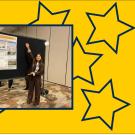
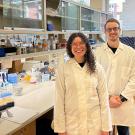
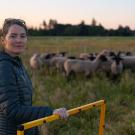
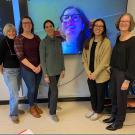
Graduate students Erika Escalona and Valentina Roel won top poster awards at the California Plant and Soil Conference, highlighting UC Davis research on soil steaming and nitrogen alternatives in sustainable agriculture.
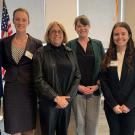
Graduate student Paige Kouba shared her climate-focused forest research with lawmakers at the state Capitol, part of a program training scientists to inform California policy through clear, nonpartisan science communication.
Air pollution and invasive weeds threaten fire-adapted wildflowers in the Santa Monica Mountains. Nitrogen from smog boosts invaders, reducing native seed banks and long-term biodiversity after wildfire recovery.
UC Davis plant scientist Grey Monroe won a $1M NSF CAREER Award from the National Science Foundation to study how plants protect key genes from harmful mutations. His work could boost gene editing and crop resilience and involve underrepresented high school students.
UC Davis early-career scientists attended the ASTA Vegetable and Flower Seed Conference to network with global seed companies and explore careers. Sponsored by Seed Central, the event offered insight into industry trends and innovation.
UC Davis wheat geneticist Jorge Dubcovsky received a 7-year, $6.3M extension from HHMI to improve wheat by reducing allergens, studying flowering traits, and boosting grain yields—efforts with global food and health impact.
New tomato lines bred with Solanum sitiens—a wild plant from Chile’s Atacama Desert—may boost heat, drought, and salt tolerance in future crops. UC Davis is sharing 56 new lines for global research and breeding efforts.
After chairing the Department of Plant Sciences for seven years, Gail Taylor has taken a new appointment as the dean of Life Sciences, University College London. She will start her new role later this year.
The African Orphan Crops Consortium has trained 161 African scientists to improve 101 underutilized crops, aiming to fight malnutrition and stunting. Their work could benefit 700 million people in sub-Saharan Africa.
Rangeland scientist Leslie Roche was named the Rustici Endowed Specialist in Rangeland Watershed Science, helping California ranchers address climate, water, and land-use challenges through collaborative research.
Truman Young retired as a professor and restoration ecologist from the UC Davis Department of Plant Sciences. His work has taken him to Africa and beyond, helping communities restore and manage landscapes.
Robert Hutmacher retired in 2022 as professor of the University of California Cooperative Extension, based in the Department of Plant Sciences. He is also the director of the UC West Side Research and Extension Center. His research has focused on cotton, primarily in California's San Joaquin Valley and other cotton-producing states.
Kent Bradford retired in 2019 as a distinguished professor emeritus in the Department of Plant Sciences. He was the founding director of the UC Davis Seed Biotechnology Center. His research has focused on the development, maintenance and expression of seed quality.
UC Cooperative Extension specialist Louise Ferguson used her Webster Award to launch a leadership program for early career women faculty, helping them build self-awareness, peer networks, and tools for career advancement.
John Yoder retired as a professor in the UC Davis Department of Plant Sciences after building a career focused on parasitic weeds and developing crops that resist them.