



Castaneda Martinez Wins California Native Plant Society Award
Like the State Grass, This Grad Student Didn’t Wilt in the Heat

Marco Castaneda Martinez is one of two students who have received the inaugural Betsey Landis Award from the California Native Plant Society, which includes a grant of $1,500. Castaneda Martinez is a doctoral student working with Justin Valliere, an assistant professor of Cooperative Extension in the Department of Plant Sciences.
The grant supports Castaneda Martinez’s research to understand what seed traits would most likely help California’s state grass, purple needlegrass (Stipa pulchra), weather increasing heat and drought. With roots 2 to 16 feet deep, this long-lived, perennial bunchgrass offers food and shelter for many creatures and works hard for landscape restoration to stabilize soil, capture stormwater and sequester carbon.
Growing up in the area between East Los Angeles and Monterey Park, Castaneda Martinez didn’t realize what he was missing until he was 9 years old, when he left his semi-industrial neighborhood for a sleepaway camp in the mountains.
“That's when I realized that the world was big,” he said. “It just clicked in my head like, ‘Whoa! I just want to spend more time here!’” Film developed from the disposable camera his mother gave him was filled, not with images of smiling faces, but with close-ups of tree bark, pine cones and grasses.
During his first year at East Los Angeles College, a grueling, five-unit Saturday biology class sealed his love for nature – and his career path. “I really excelled at remembering the plant families and the insect orders,” said Castaneda Martinez, now 33 and a second-year student in the ecology graduate group. “It reminded me of what I enjoyed doing.”
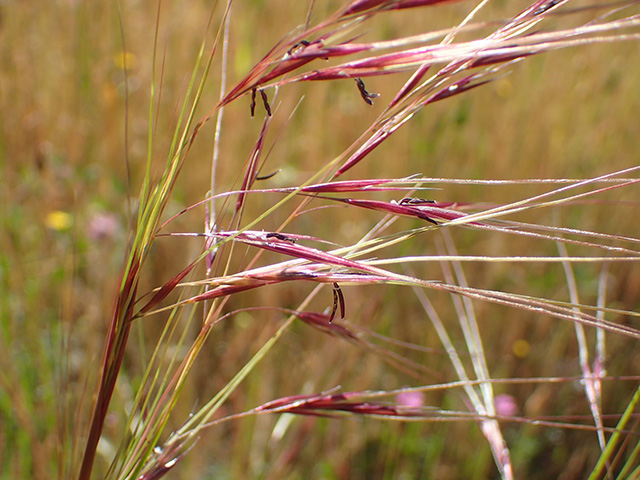
Purple needlegrass gets its name from the graceful, purple-tinted seed heads that turn light tan when mature. The society’s award allows him to buy laboratory equipment and chemicals to test seeds sourced from eight populations throughout California. Final results won’t be ready until the end of this year. But, early experiments show that germination strategies may vary within – and not just across – species and could be driven by local adaptation. If so, the source of seed could become an important consideration for people selecting seeds for restoration.
The supplies also give Castaneda Martinez the opportunity to teach laboratory techniques to undergraduates and educate even more people in the study of native plants.
Landis Award supports research in plant habitats

Castaneda Martinez first saw the long, slender stalks of purple needlegrass on a hike in Malibu Creek State Park, in the Santa Monica Mountains of coastal Southern California. He was intrigued to see it flourish amid other grasses that were dry and brown in the middle of an intense spring heatwave. He wondered what helped it survive from as far north as Redding, Calif., to as far south as Baja California, Mexico.
Eventually, he hopes his experience would lead to a job with University of California Agriculture and Natural Resources, where academic research is applied to restoration.
“California is getting warmer, and droughts are intensifying,” Castaneda Martinez said. “By understanding how native plants respond to climate change, we can help better design conservation and restoration methods to keep our plant communities resilient to stressors and disturbances.”
He also feels a personal connection. “This little plant just kind of reminds me of myself,” Castaneda Martinez said. “It's able to handle so many different environments and so many different stressors and still thrive."
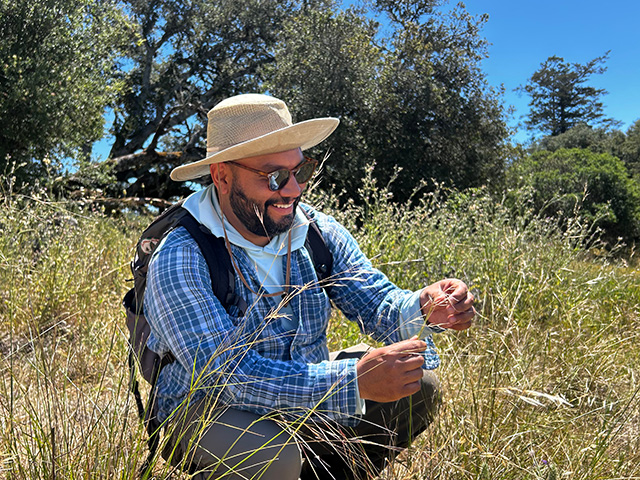
The Betsy Landis Award recognizes work studying plant habitats in the Santa Monica Mountains.
This new CNPS student research grant is named after the late society Fellow who was a longtime advocate for native plants and conservation. Landis’ work helped lead to the preservation of green spaces including the 10.2-acre San Vicente Mountain Park and the 20,000-acre wilderness area around upper Mandeville Canyon. She also worked with several schools to create native plant gardens and co-wrote two resource books on native plant horticulture. The award was established through the support of the Hauer, Chamberlin and Russell families, who lived next door to Landis for decades.
Media Resources
Learn more about the California Native Plant Society here.
Read Carren Jao’s original story about the Betsy Landis Award here, in the summer edition of the CNPS publication Flora, p. 21.
Carren Jao is an award-winning journalist, content strategist for mission-driven organizations and principal of Red Thread Consulting. Learn more about her here.
Learn more about purple needlegrass here and here.
This story was edited by Trina Kleist, UC Davis Department of Plant Sciences.