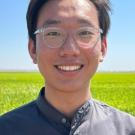
Doctoral student Marco Castaneda Martinez won the inaugural Betsey Landis Award from the California Native Plant Society, including a $1,500 grant, for research on purple needlegrass, California's state grass.
Undergrad Jackeline Limon won a $5,000 grant from Breathe California to take soil samples from 15 Yolo County locations and measure bits of plastic pollution in them.
Xiaofei Zhang, in the UC Davis Department of Plant Sciences, has a federal grant to develop bread wheat that will grow short, but without the problems that come with short-stature wheat currently available.
Wildflowers such as poppies and lupine mix strategies to survive drought: some risky and others conservative, both above-ground and below. Research from the lab of Jennifer Funk of the UC Davis Department of Plant Sciences.
The California Native Plant Foods Celebration and Symposium is organized by a team lead by Dan Potter, chair of the UC Davis Department of Plant Sciences. Panelists and demonstrations.
UC Davis Plant Sciences students earned first-place oral and poster awards at the CANVAS annual meeting. Research focused on oak restoration and water-efficient wheat that still delivers strong yields and quality bread.
Arnold Bloom is featured in a series about aptly named Aggies. That’s because his name is an aptronym -- suited to his profession or personality. He is also a distinguished professor in the UC Davis Department of Plant Sciences.
Researchers at the UC Dry Bean Field Day shared progress on developing bean varieties with higher yields, larger seeds, and better drought, heat, and disease tolerance, using tools such as drones and robotics to accelerate breeding and field testing.
Scientists statewide are testing varieties of large-seeded and baby limas, both bush and vine types, for qualities that are great for consumers and for growers facing a range of conditions. Research updates were presented at the 2025 UC Dry Bean Field Day.
Zhenglin Zhang, a Ph.D. student who studied with the UC Davis Department of Plant Sciences, has received the Kinsella Memorial Prize for writing a dissertation that is original, of high quality and multidisciplinary.