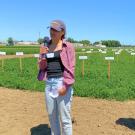
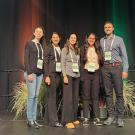
Four emerging scientists connected to the Department of Plant Sciences -- Forrest Li, Michele Nalle, Cree King and Jonathan Berlingeri -- have been named Borlaug Scholars for 2025 by the National Association for Plant Breeding.
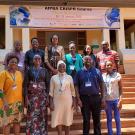
A course that trains African scientists to use genetic tools to improve food production on the continent has begun its third round, with guidance and support from UC Davis. The African Plant Breeding Academy empowers scientists with cutting-edge tools like CRISPR to tackle complex agricultural challenges and support sustainability on their continent.
Department researchers are revealing important ways that universities, government agencies and other support organizations can help our food producers develop resilience to environmental challenges and remain profitable.
The 2025 Rustici Rangeland Science Symposium at UC Davis will unite experts to address climate resilience, wildfire risks, and wolf-cattle conflicts. With key talks and networking, the event fosters solutions for sustainable rangeland management in California’s evolving landscapes.
Chris van Kessel -- founding chair of the UC Davis Department of Plant Sciences -- was deeply impacted by his nephew's battle with cancer at the age of 10. Now, van Kessel is cycling to support childhood cancer research, and he's inviting your support.
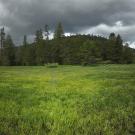
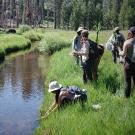
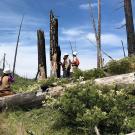
A unique partnership takes UC Davis students to Lassen Volcanic National Park to study the flora of this special area in far-northeastern California. Local communities and park visitors benefit, too.
Graduate students Isabel Ortega-Salazar and Saskia Mesquida Pesci swept the Young Minds awards for the best student oral presentations at the Postharvest 2024 International Conference, recently hosted by the International Society for Horticultural Science.
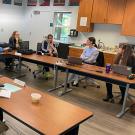
Six women leaders from around the world spent fall at UC Davis, enhancing leadership and research skills to improve food systems in their home countries. Funded by a USDA grant, the program fosters collaboration, technical training, and gender-aware learning for lasting impact.
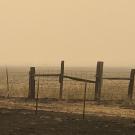
The people who produce our food need support -- especially in the areas of mental and physical well-being -- to recover from increasingly widespread wildfire, scientists have found. Postdoctoral researcher Natalia Pinzon Jimenez suggests the federal Farm Bill could help by funding programs for producers.
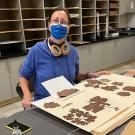
A scraggly grapevine collected in 1906 and stored at the UC Davis Center for Plant Diversity Herbarium has yielded clues to when Pierce's disease arrived in California and how the bacterium that causes it has evolved since then. Scientists hope to use that information to prevent and, eventually, treat the deadly blight, which has spread to wine-growing regions around the world.
In hotter, drier areas where natural regeneration is weaker, well-timed tree planting can boost post-fire forest recovery by up to 200 percent, according to research by Andrew Latimer and Derek Young, in the Department of Plant Sciences.
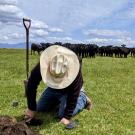
Research shows ranchers benefit from planning for extreme weather, but climate-smart strategies alone aren’t enough. A new $990K USDA grant will support training, outreach, and resources to help ranchers adapt to drought and climate change.
Mohsen Mesgaran, at the UC Davis Department of Plant Sciences, and team are developing a chatbot powered by artificial intelligence to help growers, backyard gardeners, landowners and others identify and treat weeds. The state Department of Food and Agriculture is funding the project with a grant of nearly $430,000. The development is expected to take two years.
A team of scientists, including Gail Taylor of the UC Davis Department of Plant Sciences, has identified a gene in poplar trees that enhances photosynthesis and can boost tree height by as much as 200 percent. Discovery of the “Booster” gene has enormous potential for both the nation’s efforts to create plant-based jet fuel and to boost the yield of key food crops.
UC Davis plant scientists Eduardo Blumwald and Tom Buckley were named 2024 Highly Cited Researchers by Web of Science. Their influential work on crop stress and plant-water relationships ranks in the top 1% of citations, highlighting global impact.